Content
Nebraska On-Farm Research Network
Crop Yield Response to Sulfur
Protocol developed by Javed Iqbal, Extension Nutrient Management Specialist, and Aaron Nygren, Nebraska Extension Educator
Objective: Evaluate corn, soybean, or wheat yield response and economics to sulfur application
Specific prediction of S deficiency in corn, soybean, or wheat, and crop response to applied S fertilizer, remains unclear in Nebraska. Recently, some crop fields in Nebraska have shown sulfur deficiency symptoms. Crop response to S fertilizer can be variable and is affected by weather, cropping systems management (e.g., previous crop, residue and tillage management, manure, irrigation), and soil properties (e.g., texture and organic matter content). This study aims to evaluate crop yield responses to sulfur application in corn, soybeans, and wheat across Nebraska.
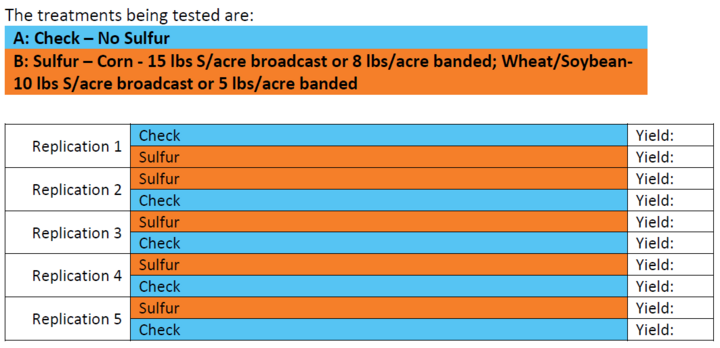
Treatment Design: The following is an example treatment design for this trial. A total of 5 replications should be implemented and harvested. The same hybrid/variety and management practices (other than S) should be used across the entire study area. Each treatment strip needs to be at least as wide as one full header width.
Data to be collected
1. Pre-plant soil sampling at 0-8” depth for analysis of basic soil properties and SO4-S, and 0-24” for S04-S
2. Early season stand counts. Each treatment in all replications should have a stand count recorded. It is recommended that at least 3 counts be averaged together for each reported stand count. Guidelines on collecting stand counts for winter wheat at
https://croptechcafe.org/wp-content/uploads/2020/04/Evaluating-Winter-Wheat-Stands.pdf 3. Yield for each strip via weigh wagon or yield monitor. If using a yield monitor, it must be well calibrated. Grain moisture for each individual weight should also be recorded.
4. Site rainfall records will be obtained from interpolated radar estimates.
5. Other information including soil type as defined by USDA, previous tillage conditions, hybrid planted, tillage system, residue type, planting depth, and others will be required to be provided by the grower.
Nebraska On-Farm Research Network Agrees to:
1. Provide technical assistance in setting up replicated and randomized experimental design.
2. Provide assistance upon request with soil sampling, treatment implementation, flagging, stand counts, and recording yield.
3. Analyze raw data using statistical analysis and provide this information to the grower.
Grower Agrees to:
1. Complete background agronomic form providing important ancillary agronomic information to Nebraska Extension.
2. Accurately record locations of the strips by flagging or GPS.
3. Record yield and grain moisture data. Separate regions or loads should be used in the yield monitor to identify each strip of untreated and Procure treatments. Raw GPS yield data files or weigh wagon data must be provided to Nebraska Extension within 30 days of harvest or by Dec. 1.
4. Allow Nebraska Extension to use submitted and collected data for research, educational, and informational purposes.